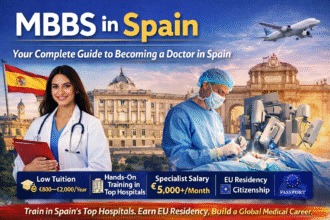
Spain’s MIR (Médico Interno Residente) pathway is one of the most structured, transparent, and financially viable routes for non-European (extra-EU) MBBS graduates to become medical specialists in the European Union. Unlike many destinations, PG in Spain is salaried, residency training is delivered in public hospitals, and specialist qualifications are EU-recognized.
This comprehensive guide explains eligibility, language requirements, MBBS homologation, MIR exam format, quotas for non-EU candidates, timelines, costs, and a practical step-by-step roadmap—with an end-to-end support model offered byStudy in Spain Guide from Spanish enrolment to residency card issuance.
Why Choose Spain for Medical PG (MIR)?
Paid Residency: MIR residents are salaried public employees (€1,500 to €3,500)
EU-Recognised Training: Specialisation in Spain is recognised across the EU.
High-Quality Public Hospitals: Structured residency (4–5 years depending on specialty).
Long-Term EU Pathway: Legal residence during training with a clear professional trajectory.
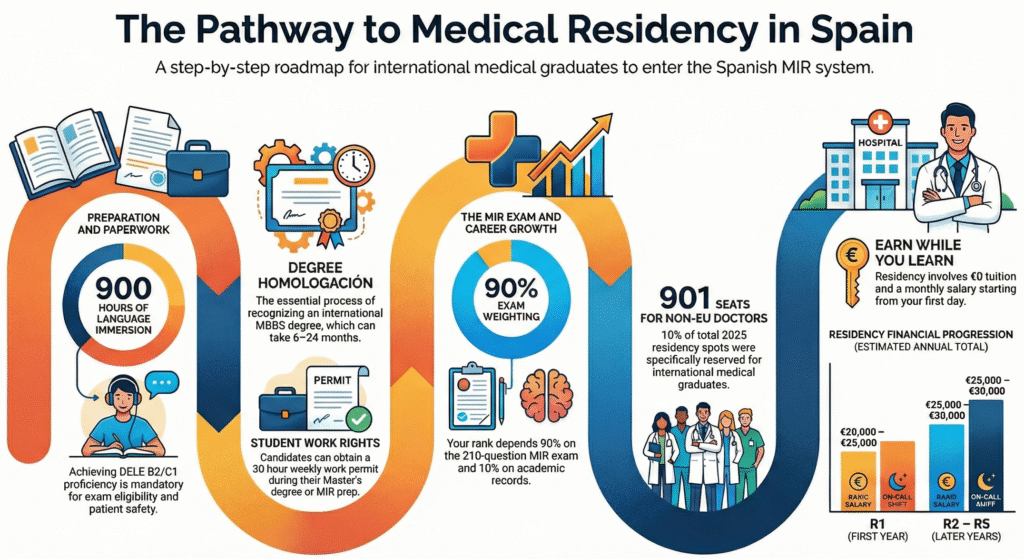
Resident salary (indicative): Annual base pay rises each year; on-call shifts (guardias) add meaningful increments.
Medical PG Pathway
MIR 2025 Snapshot for Non-EU Candidates
Total MIR seats (Medicine): 9,007
Non-EU quota: 10% (≈ 901 seats)
Non-EU candidates sat MIR 2025: 1,679
Non-EU candidates who secured seats: 901 (≈53.6% success among those who passed)
These figures show both high participation and realistic competitiveness for non-EU applicants.
Eligibility for Non-European Doctors
To take the MIR exam, you need:
MBBS Degree Homologation (Recognition) in Spain
Spanish Proficiency: DELE B2 or C1 (C1 preferred for clinical fluency)
MIR Exam Registration & Ranking
Valid Legal Stay (Student/Residence status) during preparation and selection
Step-by-Step Roadmap (Non-EU → MIR → Residency in Spain)
Step 1: Learn Spanish (A1 → B2/C1)
MIR and residency training are conducted in Spanish. An accelerated, immersive Spanish pathway (≈900 hours) with DELE B2/C1 preparation is recommended. Cultural and healthcare-system familiarization improves clinical readiness.
Step 2: MBBS Degree Homologation (Recognition)
Apply for Homologation while learning Spanish. Typical documents: Apostilled MBBS degree + transcripts (Spanish translation), passport, DELE certificate. Timeline: ~6 months to ~24 months (case-dependent).
Cut-off: Minimum threshold required to enter seat selection
Step 4: Seat Selection, Quota & Start of Residency
Non-EU quota applies during selection rounds.
Higher rank = wider choice of specialties/hospitals.
Contract with hospital → residency starts (typically May).
If no seat: retake MIR next cycle.
Can Non-EU Doctors Work in Spain Without MIR?
Yes, limited options exist without MIR:
After homologation + DELE B2/C1, register with the Colegio Oficial de Médicos (regional medical council).
Private sector roles (e.g., GP in private clinics) may be possible.
Public-sector specialist roles require MIR.
What to Do While Waiting for Homologation?
Productive pathways during the waiting period:
Continue Spanish to C1
Enrol in a relevant Master’s (e.g., Clinical Medicine / Hospital Management)
MIR preparation (10+ months recommended)
Student stay with part-time work up to 30 hours/week (where applicable)
Costs, Fees & Realistic Budgeting
Structured Pathway Package:€12,500 includes intensive Spanish (public university hours), DELE prep, Spanish for medical purposes, MBBS homologation application support, 1-year health insurance, study-visa guidance, arrival services (SIM, bank account, town hall registration, TRC support), Master’s option, and MIR preparation (10+ months).
Living costs: ~€600 per month; city-dependent (Madrid/Barcelona living expenses can be little higher)
Public residency tuition Fee: €0
Tip: Budget separately for apostille/translation and Spanish health Insurance.
Ignoring non-EU quota dynamics when setting specialty targets
Fragmented prep (language, homologation, MIR done in silos)
FAQs – MIR in Spain for Non-EU Doctors
Q1. Is MIR recognised across the EU? Yes. Spanish specialist training is EU-recognised.
Q2. Can I work part-time during preparation? Student stays can allow up to 30 hours/week during eligible programs.
Q3. How competitive is MIR for non-EU candidates? Non-EU seats are capped (~10%). In 2025, ≈53.6% of non-EU candidates who passed secured seats.
Q4. Do I pay tuition for residency? No. Residency is part of the public system; residents are salaried.
For non-European MBBS graduates, MIR in Spain offers a legitimate, salaried, EU-recognized pathway to specialization—provided you plan early for Spanish proficiency, homologation, and MIR competitiveness. With Study in Spain Guide’s end-to-end support, candidates can move through each regulatory step efficiently and compliantly—from Spanish enrolment to TRC issuance—maximizing their probability of securing a residency seat.
Next step: Book a consultation with Study in Spain Guide to receive a personalized MIR roadmap (language plan, homologation timeline, specialty strategy, visa checklist).